
Ultraviolet (UV) lighting tools are widely used across industries, from forensic investigation and industrial inspection to curing adhesives and mineral hunting. Two of the most common devices are UV lamps and UV flashlights.
While both serve similar purposes, they differ significantly in design, performance, and application suitability. Choosing the right tool depends on your specific needs. Many professionals work with a Professional Flashlight Manufacturer to ensure they get optimized UV lighting solutions tailored to their use case.
This guide provides a detailed comparison of UV lamps and UV flashlights, helping you make the right decision.
What Is a UV Lamp?
A UV lamp is typically a stationary or large-area lighting device designed to emit ultraviolet light over a broad surface.
Key Characteristics
- Wide coverage area
- Stable and continuous output
- Often used in fixed setups
- Available in multiple wavelengths
Common Uses
- UV curing (resins, adhesives, coatings)
- Laboratory analysis
- Sterilization processes
- Industrial inspection lines
What Is a UV Flashlight?
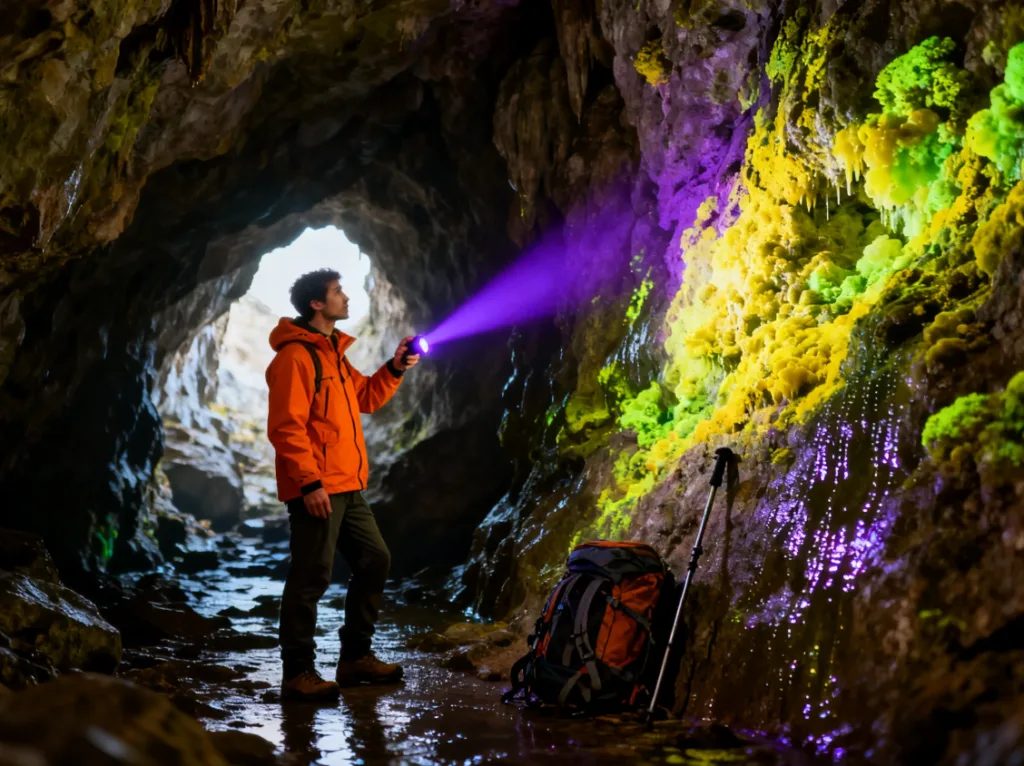
A UV flashlight is a portable handheld device that emits focused UV light for targeted inspection.
Key Characteristics
- Compact and portable
- Directional beam
- Battery-powered
- Ideal for field use
Common Uses
- Leak detection
- Forensic investigation
- Mineral hunting
- Currency verification
UV Lamp vs UV Flashlight: Key Differences
| Feature | UV Lamp | UV Flashlight |
|---|---|---|
| Portability | Low | High |
| Coverage area | Wide | Focused |
| Power source | Plug-in | Battery-powered |
| Precision | Moderate | High |
| Mobility | Fixed | Mobile |
| Typical use | Industrial processes | Field inspection |
UV lamps are better for large-area applications, while UV flashlights excel in precision and portability.
Wavelength Considerations
Both UV lamps and flashlights operate in different wavelength ranges, which determine their effectiveness.
| Wavelength | Type | Application |
|---|---|---|
| 254 nm | UV-C | Sterilization |
| 302 nm | UV-B | Specialized lab use |
| 365 nm | UV-A | Inspection, forensics, minerals |
| 395 nm | Near UV | General-purpose use |
For most inspection tasks, 365 nm UV-A light is preferred due to its balance of safety and performance.
For more details on UV radiation, visit:
https://www.epa.gov/radiation
Application-Based Comparison
1. Industrial Curing
| Requirement | Best Option |
|---|---|
| Large surface curing | UV Lamp |
| Precision curing | UV Flashlight |
UV lamps provide consistent exposure across large surfaces, making them ideal for curing coatings and adhesives.
2. Leak Detection
| Requirement | Best Option |
|---|---|
| Field inspection | UV Flashlight |
| Production line testing | UV Lamp |
UV flashlights allow technicians to inspect specific areas quickly and accurately.
3. Forensic Investigation
| Requirement | Best Option |
|---|---|
| Crime scene investigation | UV Flashlight |
| Lab analysis | UV Lamp |
Portable UV flashlights are essential for on-site investigation.
4. Mineral Hunting
| Requirement | Best Option |
|---|---|
| Outdoor exploration | UV Flashlight |
| Controlled lab analysis | UV Lamp |
UV flashlights are the preferred choice due to portability and focused beams.
5. Currency and Document Inspection
| Requirement | Best Option |
|---|---|
| Portable verification | UV Flashlight |
| High-volume checking | UV Lamp |
Advantages of UV Lamps
- Ideal for large-area illumination
- Stable and continuous light output
- Suitable for industrial automation
- High power for curing applications
Advantages of UV Flashlights
- Lightweight and portable
- High precision for targeted inspection
- Easy to use in field conditions
- Flexible for multiple applications
Working with a Professional Flashlight Manufacturer ensures UV flashlights are optimized with proper wavelength accuracy, filtering, and durability.
Limitations of Each Option
| Device | Limitations |
|---|---|
| UV Lamp | Limited mobility, higher cost, requires power source |
| UV Flashlight | Smaller coverage area, battery dependency |
Understanding these limitations helps in selecting the right tool.
When to Choose a UV Lamp
Choose a UV lamp if you need:
- Large-area coverage
- Continuous operation
- Industrial or laboratory setup
- High-intensity curing applications
When to Choose a UV Flashlight
Choose a UV flashlight if you need:
- Portability and mobility
- Precision inspection
- Fieldwork capability
- Multi-purpose usage
Can You Use Both Together?
In many professional settings, the best solution is to use both tools:
- UV lamps for large-scale operations
- UV flashlights for detailed inspection
This combination ensures efficiency and accuracy across workflows.
How to Choose the Right UV Device
Consider the following factors:
- Application type
- Required wavelength
- Portability needs
- Budget constraints
- Frequency of use
A Professional Flashlight Manufacturer can help tailor UV lighting solutions based on these requirements.
Conclusion
Both UV lamps and UV flashlights are essential tools, but they serve different purposes. UV lamps are ideal for large-scale, stationary applications such as curing and laboratory work, while UV flashlights excel in portability and precision for field inspections.
Understanding the differences between these devices allows businesses and professionals to choose the most effective solution for their needs. In many cases, combining both tools provides the best results.
Investing in high-quality UV lighting equipment ensures better performance, improved accuracy, and long-term reliability across a wide range of applications.


